






Benefits of load balancing iRODS
Load balancing iRODS provides the following benefits:
- Ensures data is protected
- Helps make sure data is accessible at all times
- Enables businesses to meet growing data demands through scalability
About iRODS
The Integrated Rule-Oriented Data System (iRODS) is an open source data management software used by research organizations and government agencies worldwide. iRODS is released as a production-level distribution aimed at deployment in mission-critical environments. It virtualizes data storage resources, so users can take control of their data, regardless of where and on what device the data is stored. As data volumes grow and data services become more complex, iRODS is serving an increasingly important role in data management.
Why Loadbalancer.org for iRODS?
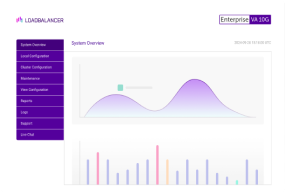
Loadbalancer’s intuitive Enterprise Application Delivery Controller (ADC) is designed to save time and money with a clever, not complex, WebUI.
Easily configure, deploy, manage, and maintain our Enterprise load balancer, reducing complexity and the risk of human error. For a difference you can see in just minutes.
And with WAF and GSLB included straight out-of-the-box, there’s no hidden costs, so the prices you see on our website are fully transparent.
More on what’s possible with Loadbalancer.org.
How to load balance iRODS
Every iRODS Zone requires an iCAT Enabled Resource Server (iCAT) server, so the Zone becomes inaccessible if the iCAT goes down. The Loadbalancer.org appliance will distribute network traffic across multiple iCAT servers, guaranteeing uptime and scalable performance for critical, high load iRODS environments. The load balancer is deployed at Layer 7. This mode requires no changes to the load balanced iRODS iCAT servers.
The Integrated Rule-Oriented Data System (iRODS) is an open source data management software used by research organizations and government agencies worldwide. iRODS is released as a production-level distribution aimed at deployment in mission-critical environments. It virtualizes data storage resources, so users can take control of their data, regardless of where and on what device the data is stored. As data volumes grow and data services become more complex, iRODS is serving an increasingly important role in data management.
Timeouts
For iRODS iCAT, the Layer 7 client and server timeouts are set to 1 minute.
Requirements
The following table shows the port(s) that are load balanced:
| Port | Protocol | Use |
|---|---|---|
| 1247 | TCP | iRODS communications |
Health checks
By default, a simple ‘Connect to port’ health check is used by the Virtual Service described in the deployment guide below.
If required, a more comprehensive negotiate check can be configured to provide a more robust check.